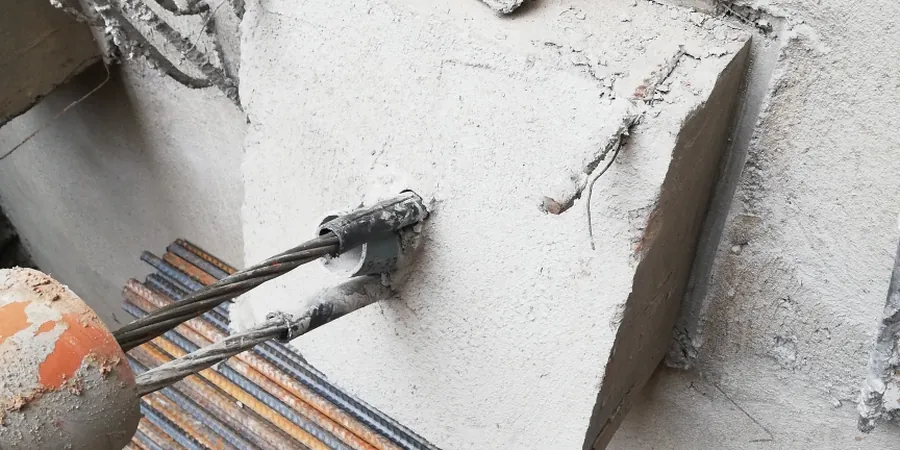
In Swords, where the glacial till overlies limestone bedrock and the Ward River valley introduces layers of soft alluvium, excavation support is rarely a one-size-fits-all proposition. We have inspected enough cut-and-cover schemes along the R132 corridor to know that the difference between an active and a passive anchor is not just academic—it dictates the allowable deflection and the sequencing of your entire dig. A pre-stressed active anchor locks in load from the start by mechanically tensioning the tendon against the bearing plate, while a passive anchor only mobilises resistance once the ground starts to deform. In mixed profiles where stiff boulder clay transitions into weathered shale, combining both types within the same soldier pile wall often yields the most predictable deformation envelope—provided you calibrate the lock-off load against the slope stability analysis for the retained height.
An anchor is not just a steel tendon—it is a load-transfer mechanism whose reliability depends entirely on the grout-to-ground interface and the lock-off discipline applied on site.
Local considerations
A five-storey mixed-use development near the Swords Pavilions car park encountered unanticipated ground conditions when the excavation for a single-level basement reached 4.5 m depth. The original design specified a single row of passive anchors through the glacial till, but the exposed face revealed a lens of saturated silt that had been missed during the site investigation. After just 48 hours of exposure, the wall deflected 28 mm at the crest, cracking a 100 mm foul sewer that ran parallel to the excavation. We were brought in to design a remedial anchored system that combined an upper row of active strand anchors—immediately tensioned to 250 kN to arrest movement—with a lower row of longer passive bars that would engage as the excavation deepened. A continuous excavation monitoring programme with inclinometers and load cells on three anchors confirmed that deflections stabilised within 4 mm of the lock-off value, and the sewer repair was completed without further disruption. The lesson is that in Swords, where the drift geology can change within metres, the anchor design must be treated as a live document that adapts to the ground actually encountered, not just the one assumed in the borehole log.
Frequently asked questions
What is the difference between an active and a passive anchor in practical terms?
An active anchor is mechanically tensioned against the wall or structure after the grout has cured, applying a pre-determined lock-off load that immediately restrains movement. A passive anchor is simply grouted into the borehole and only develops its reaction force as the ground deforms and pulls on the bar. For projects in Swords where adjacent buildings or services are sensitive to settlement, active anchors provide far better deflection control.
What testing is required for anchors under Irish and European standards?
EN 1537:2013 requires investigation (suitability) tests on sacrificial anchors to confirm the ultimate bond capacity before production drilling begins. Every production anchor must then undergo an acceptance (proof) test to at least 1.25 times the service load, with a creep monitoring period. We also specify extended creep tests on a defined percentage of anchors where the ground conditions are variable or where long-term relaxation is a concern.
How much does an anchor design package typically cost for a project in Swords?
Depending on the complexity and the number of anchor rows, a full design package—including ground parameter review, anchor geometry, tendon specification, and testing schedule—ranges from €830 to €3,870. The lower end covers simple temporary passive schemes, while the upper end includes permanent active anchors with corrosion protection and multiple testing phases.
Can anchors be installed in the limestone bedrock found beneath Swords?
Yes, and the strong limestone provides excellent bond capacity, often exceeding 1 MPa ultimate stress. The main challenge in Swords is the karstic nature of the rock in some areas, which can cause grout loss during drilling. We manage this by specifying pre-grouting of the bond zone if water loss tests indicate open fissures, ensuring a continuous grout column around the tendon.