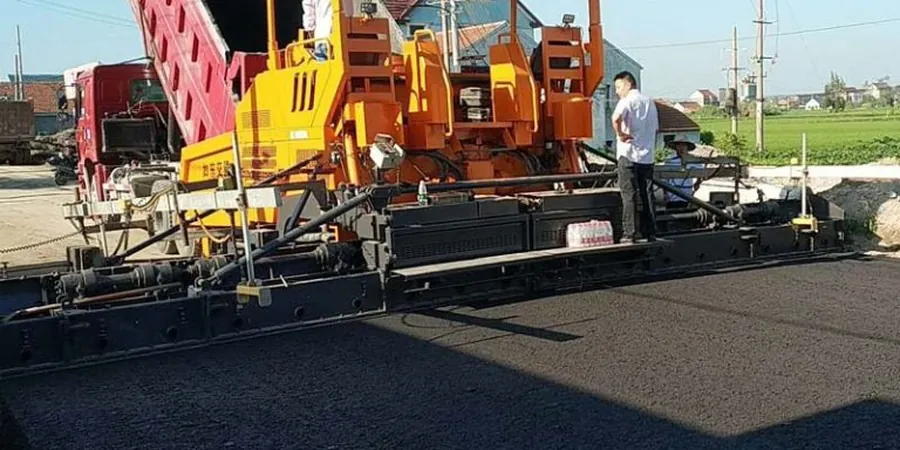
The most expensive mistake we see on Swords commercial projects is paving straight onto a formation that passed a density test but failed its stiffness requirement. Contractors get caught when the glacial till beneath the Airside or along the Ward River valley softens after the first wet winter, and within eighteen months the asphalt shows alligator cracking around the loading bays. Designing a flexible pavement here means moving beyond the standard DMRB catalogue and running a site-specific CBR investigation on the upper boulder clay, because the lab values from a bulk sample often overestimate the support you will actually get once the water table rises. We then link that stiffness profile to a triaxial analysis when the pavement is meant to carry heavy-goods vehicles with axle loads exceeding 80 kN, so the granular sub-base thickness is not just a guess pulled from a table.
A pavement is a structural system, not a cover—the subgrade contributes 60% of the long-term support, and that is where most Swords designs fall short.
Local considerations
When we mobilize the heavy-weight deflectometer and the nuclear density gauge onto a site in Swords, particularly on the tight infill plots north of the Rathbeale Road where you are paving right up to the boundary wall, the immediate risk is edge confinement failure. We have seen the outer wheel-path crack and crumble within two years because the contractor omitted a concrete edge beam and the granular base had no lateral restraint. On one HGV yard near the business park, the absence of a geogrid separator between the capping and the sub-base allowed fines to migrate upward under pumping, reducing the effective structural number by nearly 40% in the trafficked lane. That is why we specify a non-woven geotextile with a minimum grab tensile strength of 14 kN, and we verify the finished pavement deflection with a Benkelman beam test before the client takes possession.
Frequently asked questions
What is the minimum formation CBR required before capping is needed under a flexible pavement?
We follow TII guidance: if the laboratory-soaked CBR of the subgrade is below 5%, a capping layer is required. The capping must achieve a minimum CBR of 15% after compaction. In the glacial till areas of Swords, we almost always hit this threshold once the water table is within 1.5 m of formation level, so capping becomes a standard part of the design rather than an exception.
How do you account for the variable boulder clay conditions found across Swords?
The boulder clay here is not uniform—it contains silt lenses and occasional cobbles that create stiffness contrasts. We run a dynamic cone penetration grid at 10-metre spacing to identify soft pockets, then extract undisturbed Shelby tube samples from the worst areas for resilient modulus testing. The design uses the 85th percentile modulus value, not the average, so the pavement is not under-designed for the weaker zones.
What does a typical flexible pavement design for a Swords commercial yard cost?
For a standard commercial access road or yard in Swords, the investigation and design package ranges from €1,700 to €5,440 depending on the number of boreholes, the traffic class, and whether we need to run triaxial resilient modulus tests on the asphalt mix. A small car park with light traffic sits at the lower end; a heavy-goods yard with multiple loading bays and a full Benkelman beam verification programme sits at the upper end.
Can you design a pavement that will last 20 years with regular HGV traffic on the Airside?
Yes, a 20-year design life is achievable if the formation is properly prepared and the layer thicknesses are not reduced to save cost. For HGV traffic in the 8–12 msa range, we typically specify a 40 mm SMA surface course, 60 mm binder course, and 200 mm of Clause 804 granular sub-base over a capping layer. We verify the tensile strain at the bottom of the bound layers stays below 70 µε to prevent fatigue cracking, and the vertical strain on the subgrade stays below 200 µε to control rutting.