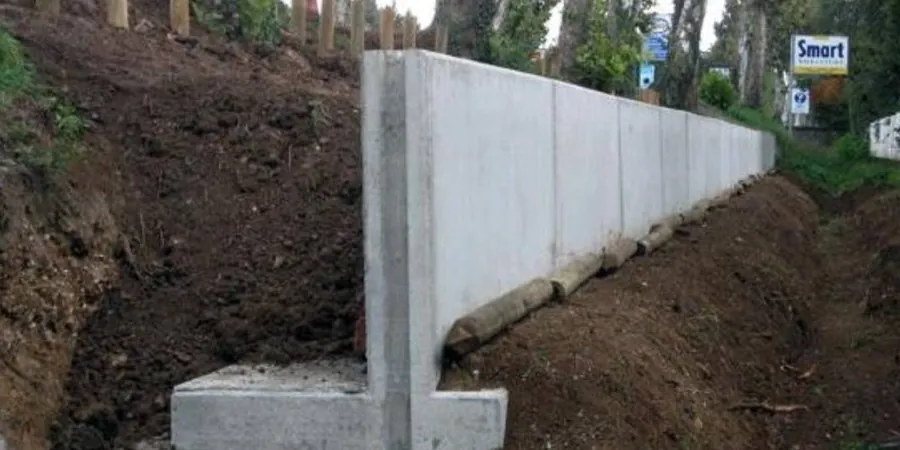
A 20-tonne excavator positioned on a residential plot off the Rathbeale Road starts digging the trench for a new retaining wall. Within minutes, the bucket brings up stiff Dublin boulder clay, the predominant subsoil across Swords. That material can stand almost vertically when dry, but its behaviour changes dramatically after a week of sustained rain. Designing a retaining wall here is not just a structural exercise. It requires a detailed understanding of the local glacial geology, groundwater fluctuations, and the lateral pressures generated by saturated soils. Before any reinforcement cage is tied or concrete poured, we run a site-specific desk study combined with field investigation. Complementing the wall analysis with a CPT test helps map the transition from made ground into the natural stiff till, while a test pit log can confirm the presence of any undocumented drainage layers left by the original estate infrastructure.
A retaining wall in Swords boulder clay must handle drained and undrained conditions equally well; the design case switches after the first heavy downpour.
Methodology and scope
In Swords, many times we see retaining walls proposed right on the boundary line, often with a level change of 1.5 to 2.4 metres between neighbouring gardens. That height sounds modest, but the surcharge from a parked car or a patio slab on the high side can double the effective lateral load. Our design process starts by verifying the soil parameters through laboratory testing on undisturbed samples. We determine the drained shear strength of the boulder clay and check for any lenses of sandy gravel that could act as a water conduit. For walls over 1.2 metres, the design must comply with the current Building Regulations (Technical Guidance Document A) and Eurocode 7 (EN 1997-1:2004). The wall geometry, reinforcement, and weep hole layout are sized to resist sliding, overturning, and bearing failure. When the retained material is particularly soft, we integrate a
slope stability analysis to verify the global safety factor. In tight urban plots, we also combine the wall design with a
footings review to coordinate the construction sequence and avoid undermining existing foundations.
Local considerations
The coastal proximity of Swords, just five kilometres from the Broadmeadow Estuary, brings high average annual rainfall and occasional intense frontal systems that saturate the top two metres of soil within 24 hours. A wall designed without adequate drainage quickly turns into a dam. Hydrostatic pressure multiplies the total lateral thrust and leads to the classic failure mode: a slow outward tilt accompanied by a tension crack along the backfill surface. We specify continuous granular drainage blankets and twin-wall perforated pipes at the base of every wall, connected to a positive outfall. Even with proper drainage, frost action on exposed cantilever stems can spall the concrete cover over time. Our specifications therefore call for air-entrained concrete (minimum XF2 exposure class) and a minimum 40 mm cover to reinforcement in aggressive ground conditions. In brownfield sites near the old Swords village core, we also screen for sulphate attack on buried concrete and specify SRPC or blended cements when required.
Frequently asked questions
How much does retaining wall design cost for a typical house in Swords?
For a standard residential retaining wall in the Swords area, the design fee ranges from €1,050 to €3,240 depending on the wall height, ground complexity, and whether a structural engineer or chartered geotechnical engineer is required to sign off. A simple garden wall under 1.2 metres with good ground will sit at the lower end, while a taller wall supporting a driveway or a boundary close to a public road moves toward the upper end.
Do I need planning permission for a retaining wall in Fingal?
Under the Fingal Development Plan, a retaining wall over 1.2 metres in height generally requires planning permission, especially where it fronts a public road or affects a neighbouring property. Even if planning is not required, the structure must comply with the Building Regulations. We always recommend confirming the specific planning status with an architect or the Fingal County Council planning desk before finalising the design.
What happens if the wall fails the sliding check?
If the sliding resistance is too low, we have several practical options. A deeper shear key can be cast beneath the base, the base width can be increased to mobilise more friction on the underside, or the backfill material can be replaced with a lightweight expanded clay aggregate to reduce the driving force. The choice depends on the site geometry and access constraints.