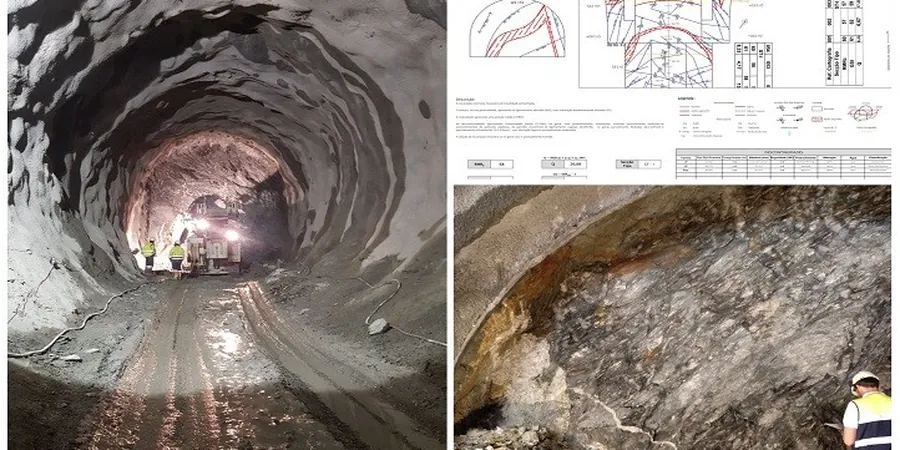
The North Dublin lowlands don't forgive assumptions. In Swords, where glacial till meets alluvial gravels and the water table sits barely two metres below street level, opening a tunnel face without a rigorous geotechnical model is a project-ending gamble. The mix of Dublin Boulder Clay—stiff, overconsolidated, but riddled with lenses of sand and silt—creates a tunnelling environment where ground behaviour can shift in the space of ten metres. Our lab in Swords runs the full sequence: advanced triaxial testing to capture undrained shear strength, consolidation tests that predict long-term settlement under the M1 corridor, and permeability profiles that feed directly into your TBM or SEM design. Pairing site-specific data with in-situ permeability measurements gives you the pore-pressure picture you actually need, not a textbook assumption. We also cross-check stiffness profiles with MASW surveys to map shear-wave velocity across the tunnel alignment, making sure the deformation model matches what the ground will really do when you excavate.
Stiff Dublin Boulder Clay can stand unsupported for hours—until it can't. The pressurised sand lenses hidden inside it are what turn a stable heading into a collapse in minutes.
Frequently asked questions
What soil conditions make tunnelling in Swords difficult?
The main challenge is the Dublin Boulder Clay—stiff, overconsolidated, but containing water-bearing sand and gravel lenses at unpredictable depths. These lenses are often under artesian pressure, so encountering one during excavation can cause sudden water inflow and face instability. The upper 3–4 metres is typically weathered, fissured clay with lower strength. Groundwater is high, especially near the Ward River, and fluctuates seasonally.
What laboratory tests are essential for a soft-ground tunnel in glacial till?
At minimum: CIU triaxial tests to establish undrained shear strength profiles at several depths; oedometer consolidation tests at in-situ stress levels for settlement prediction; Atterberg limits to classify the clay fraction; and particle size distribution to characterise the granular lenses. For FE modelling we add bender-element or MASW-derived small-strain stiffness and ring-shear tests to capture residual strength on fissured surfaces.
How much does a tunnel geotechnical investigation cost in the Swords area?
A comprehensive ground investigation for a soft-ground tunnel alignment in Swords typically ranges between €4,260 and €14,660, depending on the number of boreholes, the depth of the drive, the laboratory testing programme, and whether geophysical surveys like MASW or resistivity are included. Shallow utility-tunnel studies fall at the lower end; TBM drives under the M1 corridor with full lab suites run higher.
How do you handle the transition between weathered and intact Boulder Clay in the tunnel model?
We log the transition depth in each borehole and test pit using SPT refusal, pocket penetrometer readings, and visual inspection for fissuring and oxidation. The weathered zone is assigned lower stiffness and higher permeability parameters. We then interpolate the transition surface across the alignment in a 3D model, so the tunnel designer can segment the lining loads accurately along the drive, avoiding under-design in the critical portal zones.