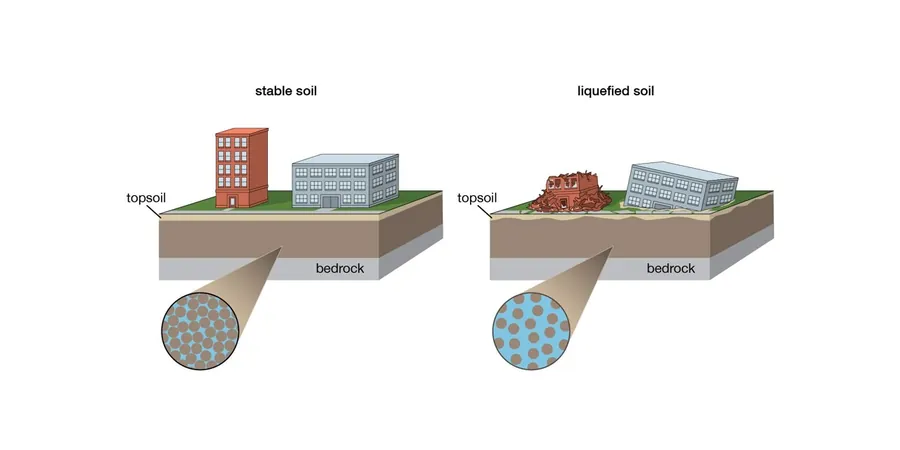
Groundwater in parts of Swords sits barely two metres below the surface, and that high water table is the first thing our engineers check when a new development is proposed near the Ward River Valley. Loose saturated sandy silts can look perfectly stable in a trial pit, but under seismic shaking they can lose strength in seconds. We run CPT testing to get a continuous resistance profile before anyone pours a foundation, because the glacial and alluvial deposits across the Fingal area do not always give up their secrets to a borehole log alone. A proper liquefaction analysis for Swords sites goes beyond a desktop screening: it correlates cone tip resistance, grain-size distribution, and the design acceleration from the Irish National Annex to Eurocode 8, so the structural engineer knows exactly whether ground improvement is needed or if the natural stratum has enough cyclic resistance.
Liquefaction is not just a seismic problem; in Swords, the shallow groundwater and fine-grained alluvial lenses turn it into a settlement problem even at moderate PGA.
Methodology and scope
Swords has grown from a village of under 5,000 to a commuter town of over 40,000 in a few decades, and the pressure to build on marginal land once passed over by farmers is real. The superficial geology here is dominated by late-glacial tills and pockets of water-lain sand, which means two boreholes 30 metres apart can tell very different stories. Our liquefaction analysis starts with SPT energy-corrected blow counts (ASTM D1586) and, wherever the client allows, a CPTu sounding that captures pore pressure as the cone advances. That data feeds into the simplified procedure — we use the NCEER/Youd-Idriss 2001 framework adapted to Eurocode 8 design spectra for Ireland — to calculate a factor of safety against liquefaction at each critical depth. The output is a clear table of cyclic stress ratio, cyclic resistance ratio, and post-liquefaction settlement estimate that the design team can take straight into their foundation calculations.
Frequently asked questions
How much does a liquefaction analysis cost for a site in Swords?
For a typical Swords residential or light-commercial site, a complete liquefaction assessment including field testing, laboratory classification, and the engineering report falls between €2,030 and €3,580, depending on the number of SPT/CPT locations and the depth of the potentially liquefiable layer.
Is a liquefaction study mandatory for every building in Swords?
Not for every building. Eurocode 8 requires it when the ground type is susceptible (saturated loose sands/silts) and the design peak ground acceleration exceeds 0.15g. Our desk study determines whether your specific plot triggers the requirement, which can save unnecessary investigation costs on gravelly or dense till sites.
What is the difference between SPT-based and CPT-based liquefaction analysis?
SPT-based analysis uses corrected blow counts and disturbed samples to estimate cyclic resistance, while CPT-based analysis uses continuous cone resistance and pore-pressure readings for a much higher-resolution profile. On Swords alluvial sites with thin sand lenses, CPT often catches weak seams that SPT intervals miss entirely.
How long does the full assessment take from start to report?
Fieldwork typically takes 2–3 days for a standard plot. Laboratory testing adds 5–7 working days, and the interpretative report follows within one week of receiving lab data. A realistic timeline from instruction to final report is three to four weeks, weather permitting for the drilling crew.