← Home · Roadway

Rigid Pavement Design in Swords: Laboratory-Backed Concrete Thickness Engineering

Together, we solve the challenges of tomorrow.

LEARN MORE →

A logistics warehouse expansion near the Swords Business Campus was shelved for three months after the initial concrete slab specification failed to account for the underlying glacial till. The original 180mm design was rejected when our lab confirmed a CBR of just 2.5% in the saturated subgrade. Swords sits on a complex mix of limestone-derived till and alluvial pockets along the Broadmeadow River, where seasonal groundwater fluctuates by over 1.2 metres. A rigid pavement here demands more than a standard county council spec. We pair in-situ permeability testing with laboratory modulus values to calibrate the Westergaard edge-loading equations, ensuring the jointed concrete layer bridges weak spots without differential settlement. The proximity to Dublin Airport also means vibration and heavy-goods traffic cycles that accelerate fatigue in under-designed slabs.

A rigid pavement slab in Swords must handle a temperature curl stress of 1.2 MPa on a summer afternoon while the subgrade support drops 30% after a wet winter.

Methodology and scope

The Department of Transport's NRA HD 26/11 and the upcoming TII rigid pavement standards set minimum flexural strengths, but Swords' ground conditions push the analysis further. Our lab runs third-point loading beams to verify a 28-day modulus of rupture above 4.5 MPa, then cross-checks against the k-value from plate-load tests on the prepared sub-base. We have seen too many slabs crack within two years because the designer assumed a uniform k-value across the site. The Broadmeadow floodplain soils vary from gravel lenses to soft clay over less than 40 metres. For heavy industrial yards, we integrate CBR road testing early in the investigation to map weak zones and adjust the granular sub-base thickness before the concrete is poured. A well-designed rigid pavement in this area distributes wheel loads across a 1.8-metre radius, keeping tensile stress at the slab bottom below the fatigue limit.
Rigid Pavement Design in Swords: Laboratory-Backed Concrete Thickness Engineering
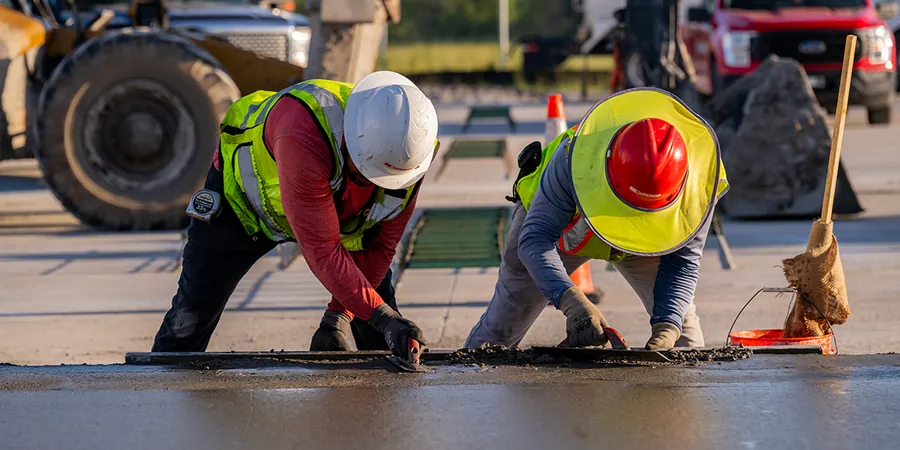
Technical reference image — Swords

Local considerations

The most expensive mistake we encounter in Swords is assuming that a single slab thickness works across the entire site. The transition from dense glacial till to soft alluvium can happen over a few metres, creating a stepped subgrade profile that induces bending moments the steel dowels cannot handle. A rigid pavement behaves like a structural plate on an elastic foundation; if the foundation stiffness halves, the tensile stress at the slab edge doubles. We have cored failed slabs in the Airside Retail Park area where the concrete was intact but the sub-base had pumped out through the joints, leaving a 30mm void. Our investigation protocol includes dynamic plate testing with a light falling-weight deflectometer at 10-metre centres to map the surface modulus before confirming the design thickness. The laboratory acredited to ISO 17025 also verifies the aggregate interlock requirements of the sub-base material, because a poorly graded crushed rock loses its load-spreading capacity once it becomes saturated.

Need a geotechnical assessment?

Reply within 24h.

Email: contact@geotechnical-engineering.co

Technical parameters

ParameterTypical value
Concrete flexural strength (28-day)> 4.5 MPa (EN 12390-5 beam test)
Modulus of subgrade reaction (k-value)27 - 54 kPa/mm (plate load test, 760mm plate)
Design traffic loadingUp to 20 million ESALs (TII/NRA)
Joint spacing (unreinforced)4.0 to 5.5 m (based on slab thickness)
Sub-base CBR requirement≥ 30% (after compaction, top 150mm)
Slab thickness range180 mm to 320 mm (doweled joints)
Freeze-thaw durabilityExposure class XF4 (I.S. EN 206)

Associated technical services

01

Concrete mix and flexural beam testing

Third-point loading tests per I.S. EN 12390-5 to confirm the specified flexural strength for Westergaard-based thickness design.

02

Subgrade reaction modulus (k-value) mapping

Static plate load tests and LWD surveys across the site to quantify foundation support variability for rigid pavement analysis.

03

Joint and reinforcement detailing

Design of dowel baskets, tie bars, and saw-cut joint spacing tailored to Swords' temperature gradients and subgrade conditions.

Applicable standards

I.S. EN 12390-5:2019 (flexural strength), NRA HD 26/11 (pavement design), I.S. EN 206:2013 + Irish National Annex (concrete specification), ASTM D1196 / BS 1377-9 (plate load test for k-value)

Frequently asked questions

What is the minimum concrete slab thickness for a rigid pavement in an industrial yard in Swords?

For a yard handling heavy-goods vehicles and occasional forklift traffic, the minimum thickness we specify is 200mm of C32/40 concrete with steel dowels at contraction joints. This assumes a compacted granular sub-base of at least 150mm, achieving a k-value above 40 kPa/mm. Lighter access roads might use 180mm, but we always verify the subgrade support with plate load tests first.

How does the glacial till in Swords affect rigid pavement design?

The till contains a high percentage of silt and clay, making it moisture-sensitive. When saturated, the subgrade modulus can drop below 30 kPa/mm, which increases the required slab thickness by 25-30% compared to a well-drained granular soil. We recommend a geotextile separator and additional sub-base thickness in the lower-lying areas near the Broadmeadow River.

What laboratory tests are required before finalising a rigid pavement design?

We run flexural strength beams (modulus of rupture at 28 days), particle size distribution and plasticity index on the subgrade, and a modified Proctor test to set compaction targets. A CBR test on the sub-base material is also essential to confirm the 30% minimum before the concrete pour.

How much does a rigid pavement design for a Swords project cost?

The geotechnical investigation and structural design of a rigid pavement typically falls between €1,530 and €5,450, depending on the site area, number of plate load tests, and laboratory testing programme required to calibrate the Westergaard model parameters.

Do you provide construction-phase testing for concrete pavements in Swords?

Yes. Our laboratory casts companion beams during each pour and tests them at 7 and 28 days. We also perform in-situ density checks on the sub-base using nuclear gauge or sand replacement methods, and verify joint alignment before the dowel baskets are concreted in.
Location and service area

We serve projects across Swords and its metropolitan area.

View larger map