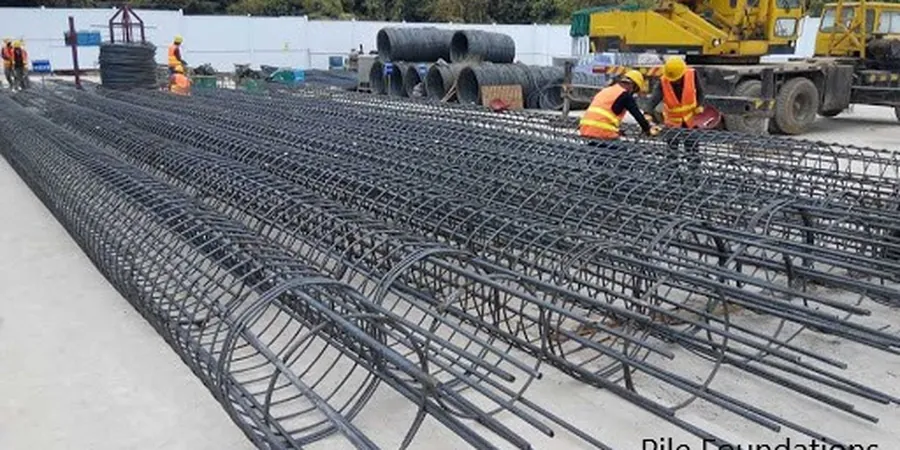
One of the most frequent — and expensive — errors we see on Swords construction sites is the assumption that shallow footings will suffice, only to encounter highly variable glacial till at depths that demand a deep foundation solution. The transition zone between the relatively stiffer Dublin Boulder Clay and the underlying limestone bedrock around the Broadmeadow River catchment can be notoriously unpredictable, and failing to account for this with a proper CPT test campaign before finalising the structural concept often leads to differential settlement that compromises the superstructure long before the project is handed over. A solid pile foundation design is not merely a structural exercise here; it is an exercise in reading the glacial history of a terrain that shifts character across distances of less than a hundred metres.
Designing piles in Swords means understanding the glacial story beneath your feet: where the boulder clay is stiff enough to grip a shaft, and where the limestone might have a surprise cavity.
Local considerations
Consider two sites separated by little more than the Ward River valley: one near the Pavilions shopping centre on slightly elevated ground, where the Dublin Boulder Clay provides excellent shaft friction for bored piles, and another closer to the floodplain near Swords Demesne, where post-glacial alluvium and soft organic silts extend to significant depths. The first scenario might yield a straightforward, high-capacity pile design with minimal settlement, while the second demands careful consideration of negative skin friction, downdrag, and potential for long-term consolidation of the compressible layers under the weight of the fill. The risk of ignoring these lateral variations is that a pile group designed for one set of conditions performs entirely differently just a short distance away, a reality that underscores the necessity of site-specific geotechnical investigation before any pile foundation design is committed to construction drawings.
Frequently asked questions
What depth of pile is typically required in the Swords area?
It varies considerably with the rockhead profile. In the central Swords area near the Main Street, we often find competent Calp limestone at 12 to 18 m depth, yielding piles of around 15 to 20 m. Closer to the estuary and the M1 corridor, where the drift is thicker, piles can extend to 25 m or more. Each design is based on a site-specific investigation because the glacial till cover is not uniform across the town.
How do you address the risk of pyrite in the subsoil?
The presence of pyritic shales within the Calp limestone and occasionally within the till matrix is a known concern in North Dublin. Our pile foundation design specifies a concrete mix designed for XA2 chemical exposure class per IS EN 206-1, and we recommend sulfate-resisting cement where the total potential sulfate content exceeds the threshold. This is determined through water-soluble sulfate testing on samples recovered from the pile bore depth.
What is the typical cost range for a pile foundation design package in Swords?
For a residential or light commercial project in Swords, a complete pile foundation design package — including the interpretative report, axial capacity calculations, and construction specifications — generally falls between €1.640 and €5.910, depending on the number of piles, the complexity of the ground conditions, and the level of construction phase monitoring required.
Can you design piles for sites with limited access, such as backland development sites in Swords village?
Yes. For constrained sites where large piling rigs cannot operate, we design solutions using mini-piles or sectional casing methods that can be installed with low-headroom equipment. The structural capacity per pile is lower, so the foundation typically involves a larger number of smaller-diameter elements, but the overall performance can be fully engineered to meet the project requirements.