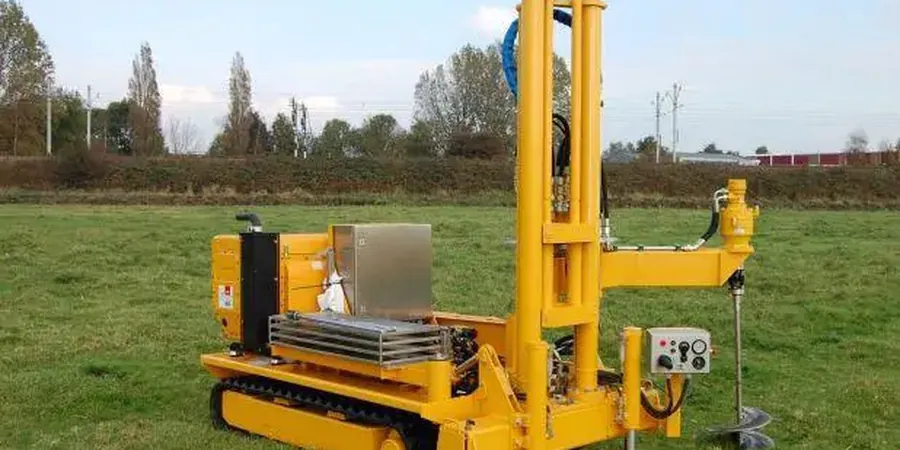
The glacial till underlying Swords — a stiff, lodgement till with scattered cobbles across the lower Ward River valley — can fool a standard borehole log. In the northern end of the town, near the Pavilions retail park, we have seen the till transition from dense to soft in less than two meters laterally. That is precisely where the Cone Penetration Test becomes indispensable. Unlike the SPT drilling that relies on discrete hammer blows, the CPT pushes a 60-degree cone continuously, capturing tip resistance (qc), sleeve friction (fs), and pore pressure (u2) at 2 cm intervals. For the layered glaciofluvial sands and gravels that wrap around Swords Castle and stretch east toward Malahide, this resolution matters. It reveals thin sand lenses that a split spoon sampler would miss entirely — and those lenses can control drainage, settlement, and bearing capacity under a shallow footing.
A single CPT sounding in Swords can replace three boreholes when the goal is to map the lateral continuity of a sand lens beneath the till.
Local considerations
Two sites, same formation, completely different risk profiles. On the elevated ground west of the Rathbeale Road, the lodgement till is dense enough to support a four-storey structure on a raft foundation with settlements under 15 mm. But down along the Ward River corridor, near the Swords Business Campus, the till is weathered and the alluvial silts contain organic lenses that generate excess pore pressure under load. Without a CPT profile in that zone, a designer might assume uniform bearing and miss the soft pocket entirely. The real hazard is differential settlement — the kind that cracks masonry within the first two years. The CPT quantifies this risk directly through the corrected cone resistance (qt) and the soil behavior type index (Ic). When Ic exceeds 2.95 in the upper 4 meters, we know we are dealing with soft, contractive silts that need either preloading, ground improvement, or a piled solution. In Swords, the contrast between the compact till and the riverine alluvium is stark, and a single CPT trace across a 50-meter transect can map that transition with survey-grade precision.
Frequently asked questions
How much does a CPT test cost in Swords?
For sites in the Swords area, a standard CPTu sounding typically ranges from €130 to €220 per meter of penetration, depending on the depth, access conditions, and whether seismic or dissipation add-ons are required. Mobilisation within north Dublin is included for projects exceeding 30 linear meters of testing. We provide a fixed-price quotation after reviewing the site location and the required investigation depth.
Can the CPT penetrate the dense glacial till in Swords?
In most locations, yes — the upper weathered till is penetrable with a standard 20-tonne rig. However, where the lodgement till contains abundant cobbles or boulders (common on the elevated ground near Rolestown Road), we may encounter refusal at depths between 8 and 15 meters. In those cases, we recommend pairing the CPT with an SPT drilling campaign to advance past obstructions and confirm the depth to bedrock.
How does the CPT identify soft layers that standard boreholes miss?
The CPT records cone resistance, sleeve friction, and pore pressure every 2 cm as the cone advances. That continuous trace captures thin sand or silt lenses — sometimes only 10 to 15 cm thick — that a split spoon sampler would skip due to the 1.5-meter sampling interval. In Swords, where the Ward River alluvium contains interbedded organic silts, these thin layers control the drainage path length and directly influence the rate of consolidation settlement.
What CPT data do I need for a shallow foundation design in Swords?
For a typical two- to four-storey residential or commercial building on the Swords till, we recommend a minimum of three CPTu soundings across the footprint to capture lateral variability. The key outputs are the corrected cone resistance (qt), the undrained shear strength profile (su), and the constrained modulus (M) for settlement calculations. If the site is within 200 meters of the Ward River, we also run dissipation tests to quantify the coefficient of consolidation in the alluvial horizon.
Is the CPT recognized for Eurocode 7 compliant design in Ireland?
Yes, the CPT is fully recognized under EN 1997-2:2007 as a primary in-situ test for soil profiling and parameter derivation. Our testing procedures comply with ASTM D5778 and ISO 22476-1, and all data is processed using the Robertson (1990) soil behavior type classification system. The results are directly compatible with the Irish National Annex parameters for bearing capacity and settlement calculations.