HomeIn-Situ Testing

In-Situ Testing in Swords

Together, we solve the challenges of tomorrow.

LEARN MORE →

In-situ testing in Swords provides direct assessment of ground conditions without sample disturbance, essential given the area’s variable glacial till and alluvial deposits near the Broadmeadow River. These investigations are carried out in compliance with IS EN 1997-2:2007 (Eurocode 7 – Ground investigation and testing) and supporting Irish Standards, ensuring reliable data for foundation design. Accurate compaction control is often verified through a field density test (sand cone method), which remains a practical on-site check for engineered fill and road subbase layers across North County Dublin.

Projects ranging from residential estates to industrial warehouses and local infrastructure upgrades routinely depend on these tests to validate bearing capacity and settlement predictions. The data gathered complements other site investigation techniques, forming a complete geotechnical profile for engineers. When combined with targeted laboratory analysis, in-situ results reduce uncertainty in ground models, particularly where soft cohesive soils or variable granular strata are encountered. This integrated approach supports cost-effective foundation solutions and earthworks specifications tailored to Swords’ subsurface conditions.

Available services

Field density test (sand cone method)

→ Ver detalle

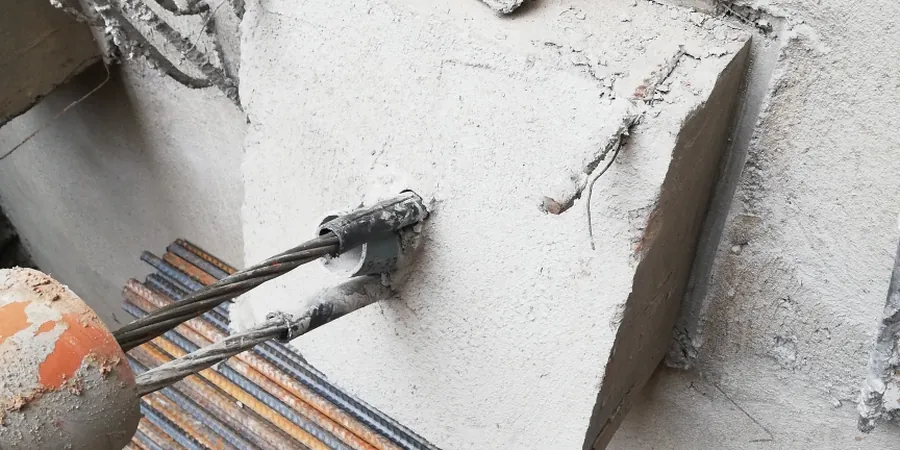
In Swords, where the glacial till overlies limestone bedrock and the Ward River valley introduces layers of soft alluvium, excavation support is rarely a one-size-fits-all proposition. We have inspected enough cut-and-cover schemes along the R132 corridor to know that the difference between an active and a passive anchor is not just academic—it dictates the allowable deflection and the sequencing of your entire dig. A pre-stressed active anchor locks in load from the start by mechanically tensioning the tendon against the bearing plate, while a passive anchor only mobilises resistance once the ground starts to deform. In mixed profiles where stiff boulder clay transitions into weathered shale, combining both types within the same soldier pile wall often yields the most predictable deformation envelope—provided you calibrate the lock-off load against the slope stability analysis for the retained height.

An anchor is not just a steel tendon—it is a load-transfer mechanism whose reliability depends entirely on the grout-to-ground interface and the lock-off discipline applied on site.

Methodology and scope

The most common mistake we see on Swords sites occurs when a contractor assumes a passive anchor will behave like a tensioned active anchor simply because it has the same bar diameter. Because the passive system must first overcome slack in the bond length before generating reaction force, it permits far more wall movement—often exceeding 15 to 20 mm before reaching design load, which can be fatal for adjacent utilities or a neighbouring shallow footing. Our approach starts with an on-site appraisal of the soil-structure interaction, followed by a sacrificial anchor test to validate the ultimate bond stress against the BS 8081 default values of 300 to 600 kPa for stiff clay. Where the limestone is karstified, we frequently recommend a grouting programme ahead of anchor installation to seal solution channels that would otherwise cause sudden grout loss during the free-length formation.
Active and Passive Anchor Design for Complex Ground Conditions in Swords
Technical reference image — Swords

Local considerations

A five-storey mixed-use development near the Swords Pavilions car park encountered unanticipated ground conditions when the excavation for a single-level basement reached 4.5 m depth. The original design specified a single row of passive anchors through the glacial till, but the exposed face revealed a lens of saturated silt that had been missed during the site investigation. After just 48 hours of exposure, the wall deflected 28 mm at the crest, cracking a 100 mm foul sewer that ran parallel to the excavation. We were brought in to design a remedial anchored system that combined an upper row of active strand anchors—immediately tensioned to 250 kN to arrest movement—with a lower row of longer passive bars that would engage as the excavation deepened. A continuous excavation monitoring programme with inclinometers and load cells on three anchors confirmed that deflections stabilised within 4 mm of the lock-off value, and the sewer repair was completed without further disruption. The lesson is that in Swords, where the drift geology can change within metres, the anchor design must be treated as a live document that adapts to the ground actually encountered, not just the one assumed in the borehole log.

Need a geotechnical assessment?

Reply within 24h.

Email: contact@geotechnical-engineering.co

Technical parameters

ParameterTypical value
Applicable design codeBS 8081:2015 + Eurocode 7 (EN 1997-1:2004)
Anchor typesActive (pre-stressed strand or bar), passive (fully grouted bar)
Typical active lock-off load80% to 110% of service load
Minimum free length (active)5.0 m or per BS 8081 Table 1
Bond length verificationSacrificial test anchor to EN 1537:2013
Proof testing frequency100% of production anchors
Creep rate limit (acceptance)≤ 1.5 mm over 60-minute log period

Associated technical services

01

Active Anchor System Design

Complete design package including tendon selection, free-length calculation, bond-length derivation from ground parameters, and lock-off procedure specification. Suitable for permanent walls, bridge abutments, and any scenario where deflection must be limited to less than 0.2% of retained height.

02

Passive Anchor and Soil-Nail Schemes

Design of fully grouted passive bars or self-drilling hollow bar systems for temporary excavations and slope reinforcement. Includes pull-out capacity verification using effective stress parameters and coordination with the temporary works designer.

03

Anchor Testing and Verification

On-site supervision of suitability tests, acceptance tests, and extended creep tests in accordance with EN 1537. We provide independent load-displacement analysis and sign-off documentation for the PSDP file.

Applicable standards

BS 8081:2015 — Code of practice for grouted anchors, EN 1537:2013 — Execution of special geotechnical work — Ground anchors, Eurocode 7 (EN 1997-1:2004) — Geotechnical design — General rules, I.S. EN 1990:2002 — Basis of structural design (Irish National Annex)

Frequently asked questions

What is the difference between an active and a passive anchor in practical terms?

An active anchor is mechanically tensioned against the wall or structure after the grout has cured, applying a pre-determined lock-off load that immediately restrains movement. A passive anchor is simply grouted into the borehole and only develops its reaction force as the ground deforms and pulls on the bar. For projects in Swords where adjacent buildings or services are sensitive to settlement, active anchors provide far better deflection control.

What testing is required for anchors under Irish and European standards?

EN 1537:2013 requires investigation (suitability) tests on sacrificial anchors to confirm the ultimate bond capacity before production drilling begins. Every production anchor must then undergo an acceptance (proof) test to at least 1.25 times the service load, with a creep monitoring period. We also specify extended creep tests on a defined percentage of anchors where the ground conditions are variable or where long-term relaxation is a concern.

How much does an anchor design package typically cost for a project in Swords?

Depending on the complexity and the number of anchor rows, a full design package—including ground parameter review, anchor geometry, tendon specification, and testing schedule—ranges from €830 to €3,870. The lower end covers simple temporary passive schemes, while the upper end includes permanent active anchors with corrosion protection and multiple testing phases.

Can anchors be installed in the limestone bedrock found beneath Swords?

Yes, and the strong limestone provides excellent bond capacity, often exceeding 1 MPa ultimate stress. The main challenge in Swords is the karstic nature of the rock in some areas, which can cause grout loss during drilling. We manage this by specifying pre-grouting of the bond zone if water loss tests indicate open fissures, ensuring a continuous grout column around the tendon.
Location and service area

We serve projects across Swords and its metropolitan area.

View larger map