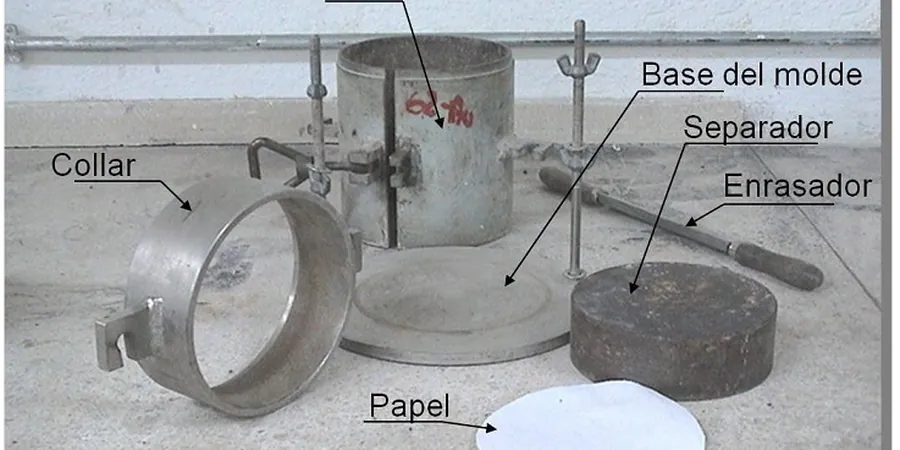
Swords has transformed from a monastic settlement into one of Ireland’s fastest-growing commuter towns, pushing development onto glacial tills and alluvial soils that require rigorous compaction control. Whether the project involves a residential extension on Rathbeale Road or bulk earthworks near Airside Retail Park, the Proctor test establishes the relationship between moisture content and dry density that every site engineer relies upon. Our laboratory determines maximum dry density and optimum moisture content under Standard (BS 1377-4:1990) or Modified compaction effort, giving contractors the target values needed to meet Specification for Highway Works Series 600. Because glacial tills can vary sharply across a site, we often pair the Proctor test with sand cone density measurements for immediate field verification and with Atterberg limits to confirm that the fine fraction is not excessively plastic. The result is a compaction specification that actually reflects the material being placed, reducing the risk of post-construction settlement in a town where housing delivery targets are among the highest in Fingal.
A one percent shift in moisture content can mean the difference between passing a compaction test and reworking an entire lift—Proctor data eliminates that guesswork.
Local considerations
The Irish climate imposes a narrow compaction window—Swords averages over 750 mm of rainfall annually spread across roughly 190 wet days, so fill material can swing from too dry to saturated within a single week. Contractors who proceed without a current Proctor curve risk either over-compacting dry soil (wasting fuel and creating a brittle fill prone to cracking) or trafficking wet soil that never reaches target density. Over-compacted cohesive fill can develop slickensides that reduce shear strength, while under-compacted granular fill settles differentially under foundation loads, leading to cracked floor slabs and service trench collapse. We have seen projects where imported stone from a Dublin quarry was assumed to compact like the site-won till, only to discover the optimum moisture was three percentage points lower—the entire lift had to be scarified, dried, and recompacted at significant cost. A project-specific Proctor test costs a fraction of that rework and becomes a defensible record when the resident engineer asks for compaction compliance documentation.
Frequently asked questions
What is the difference between Standard and Modified Proctor, and which one does my project need?
Standard Proctor (2.5 kg rammer) simulates lighter compaction equipment and is typical for landscaping, general fill, and low-rise building pads. Modified Proctor (4.5 kg rammer) replicates heavy vibratory rollers and is specified for pavement subbase, runway earthworks, and structural fill under heavily loaded foundations. The project specification—usually referencing TII Series 600 or the structural engineer’s performance requirements—dictates which method to use. We recommend checking the contract documents; if unspecified, Modified Proctor is the safer baseline for any fill supporting vehicular traffic or multi-storey loads in the Swords area.
How much does a Proctor test cost in Swords?
A Standard or Modified Proctor test typically ranges from €80 to €190 depending on the number of points on the compaction curve and whether the material requires pre-treatment such as oven-drying or sieving. Rush turnaround within 24 hours carries a modest surcharge. For multi-source earthworks projects, we offer discounted batch rates when five or more Proctor curves are requested from the same site.
How long does it take to get Proctor results back from the lab?
Our standard turnaround is three working days from receipt of the disturbed sample. The test itself requires controlled drying, moisture conditioning at several water contents, and compaction at each point—processes that cannot be rushed without compromising curve quality. We do offer a 24-hour rush service when the compaction schedule is weather-critical, which is common during Swords winters when dry days are scarce.
Do I need a new Proctor test if the borrow source changes during the project?
Yes, absolutely. The Proctor curve is unique to a specific material; glacial tills in Swords can shift from silty clay to sandy gravel over short distances. If you switch to a different lift, a new borrow pit, or even a deeper horizon within the same excavation, you must run a fresh Proctor test. Using the wrong curve can lead to false passes or false fails on field density tests, and the resident engineer will almost certainly reject compaction records based on an unrepresentative laboratory reference.