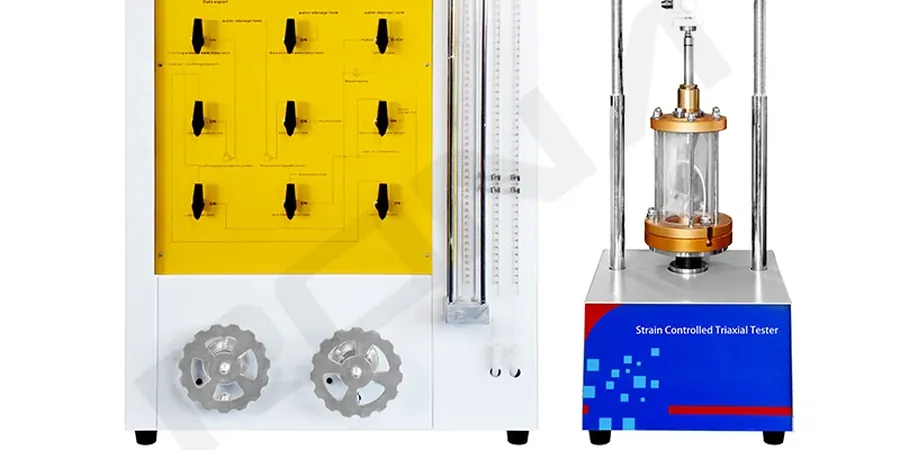
Eurocode 7 (EN 1997-1:2004) requires reliable shear strength parameters for every geotechnical design in Ireland, and Swords is no exception. The glacial tills and alluvial deposits beneath the Ward River Valley create layered ground profiles where drained and undrained behavior can vary sharply over just a few meters. A standard penetration test will flag a soft layer, but only a triaxial test can isolate the friction angle and cohesion intercept that a footing design actually needs. At our accredited laboratory, we consolidate and shear specimens under controlled back-pressure, producing effective stress paths that feed directly into Swords foundation models. For deeper site characterization, we often combine the triaxial program with CPT testing to map stratigraphic boundaries before sampling, or with grain size analysis to verify that the soil classification aligns with the measured mechanical response.
A well-run triaxial program transforms a generic borehole log into a calibrated strength envelope that reduces foundation concrete by targeting the real soil resistance.
Frequently asked questions
What does a triaxial test cost in Swords?
A single CU or CD triaxial test typically ranges from €1.510 to €2.560, depending on specimen size, consolidation stages, and whether small-strain measurements are included. A complete program of three specimens at different confining pressures is the standard package.
How long does a triaxial test take from sample to report?
Consolidation alone can take 24 to 72 hours for low-permeability silts, and drained shear adds another two to three days. A standard three-specimen program in Swords glacial soils is usually reported within three weeks of sample arrival at the lab.
Can you run a triaxial test on gravelly till from Swords?
Yes, but only on the finer matrix fraction. We sieve out particles larger than one-sixth of the specimen diameter, typically the 5 mm fraction for a 38 mm sample, and test the reconstituted matrix to represent the soil behavior between the gravel clasts.
What is the difference between a CU and a CD triaxial test?
In a consolidated undrained test, we close the drainage valve during shear and measure pore pressure, giving both total and effective strength parameters. In a drained test, the valve stays open and the strain rate is slow enough to dissipate pore pressure, directly yielding the effective friction angle and cohesion intercept.