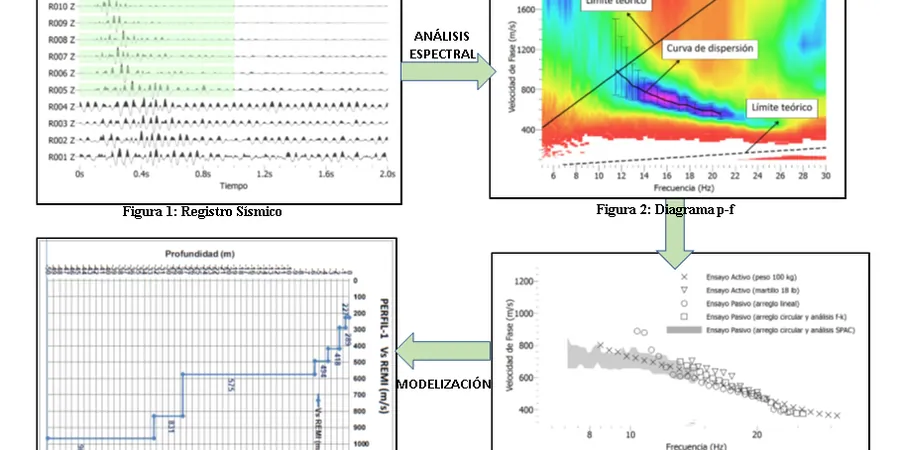
Part 1 of Eurocode 8 (EN 1998-1:2004) requires every ground investigation in Ireland to produce a VS30 value that feeds directly into the seismic design spectrum, and in Swords the local geology makes that requirement particularly interesting. Glacial tills, pockets of alluvium along the Broadmeadow River, and weathered limestone bedrock create velocity contrasts that can shift a site from Class B to Class C over just a few metres of lateral distance. Our team runs MASW arrays that capture shear wave velocity from the surface down to 30 metres, processing dispersion curves with spatial autocorrelation methods to avoid the blind spots that refraction surveys miss. For projects where the till thickness varies unpredictably we often combine the MASW profile with targeted seismic refraction lines to cross-validate the top-of-bedrock interface, ensuring the VS30 calculation uses a defensible velocity model rather than an assumed generic profile.
A VS30 value is only as reliable as the velocity model behind it, and in Swords the difference between an assumed till profile and a measured one can change the seismic design forces by 30 percent or more.
Local considerations
Swords has grown from a village centred around a medieval castle into one of the largest suburban settlements in Fingal, and that growth has pushed development onto land that was avoided for centuries. The area south of the Ward River includes low-lying ground underlain by soft alluvial clays and silts that amplify seismic waves far more than the stiff boulder clays found on the higher terraces to the north. A VS30 value below 180 m/s, which we have measured on several sites near the estuary flats, places the ground in Site Class D and can double the spectral acceleration at short periods compared with a Class B assumption. The consequence is not theoretical: a commercial building designed without a site-specific VS30 may be under-designed for the seismic demand, or alternatively over-designed with unnecessary structural cost if conservative assumptions are applied blindly. Our MASW campaigns in Swords typically include at least two orthogonal spreads per hectare, because the lateral variability in the drift deposits here is too high to rely on a single measurement point.
Frequently asked questions
When is a MASW survey required instead of a basic desk-study VS30 estimate for a Swords site?
Eurocode 8 allows estimated VS30 values only for preliminary design. For any permanent structure in Importance Class II or higher, Part 1 requires ground investigation including direct or indirect measurement of shear wave velocity. In Swords, the variability in drift deposits means that a desk-study value taken from geological maps can differ from the measured VS30 by 50 to 150 m/s, enough to misclassify the site. We recommend a MASW survey whenever the foundation design depends on the seismic base shear coefficient, particularly for buildings over three storeys or structures with irregular mass distribution.
How much does a MASW survey typically cost for a residential development site in Swords?
For a standard residential plot in the Swords area, a MASW survey with two orthogonal spreads and full VS30 reporting generally falls between €1,470 and €2,460, depending on access conditions, the number of measurement locations, and whether supplementary refraction lines or borehole tie-ins are required. We provide a fixed-price proposal after reviewing the site layout and any existing ground investigation data.
What is the difference between a MASW-derived VS30 and a downhole seismic test result?
Downhole testing measures shear wave travel times directly along a borehole at discrete depth intervals, giving high vertical resolution at the borehole location but no lateral information. MASW measures the average shear wave velocity over the entire geophone spread length by inverting surface wave dispersion, so it captures lateral variability that a single borehole cannot see. In Swords, where till thickness and composition can change across a site, we find that MASW provides a more representative VS30 for the whole footprint, while downhole testing is useful for calibrating the inversion at a specific point. The two methods are complementary rather than interchangeable.