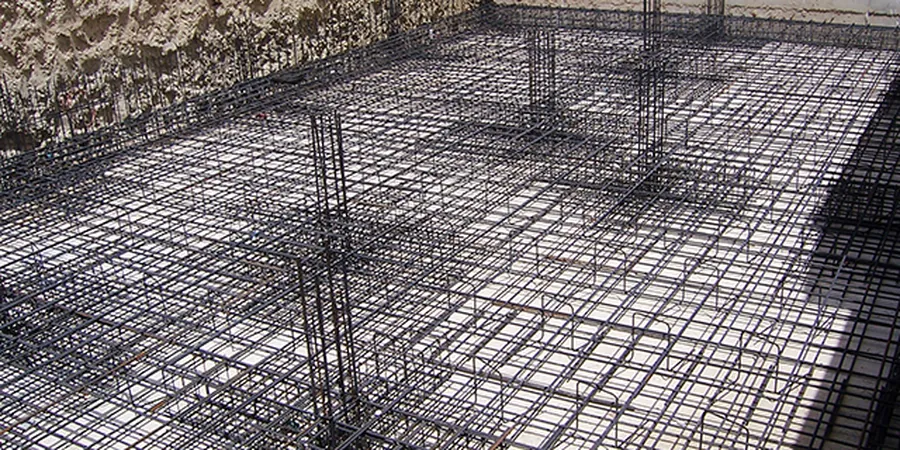
The ground beneath Swords tells two very different stories. Around the Ward River valley and towards the Malahide estuary, we consistently encounter soft alluvial silts and clays, often with peat lenses that make a standard pad foundation completely unviable. Move half a kilometre west towards the higher ground of River Valley, and you'll hit stiff Dublin boulder clay, a competent till that can support serious loads. This contrast means a single structural solution rarely fits the whole town. For the low-lying areas, a reinforced concrete raft foundation spreads the load over the entire footprint, bridging the soft spots and controlling differential settlement. The design hinges on accurate modulus of subgrade reaction values derived from in-situ permeability and consolidation testing, not just a desktop assumption. We've watched too many projects stall because the initial site investigation stopped at three shallow trial pits and missed the deeper compressible layer that a raft must be designed to float over. In Swords, the water table is often within two metres of ground level, which adds hydrostatic uplift to the design brief and makes a well-detailed raft essential from day one.
A raft foundation in Swords isn't just a thick slab; it's a calibrated system designed to manage variable compressibility and a high water table simultaneously.
Local considerations
A three-storey apartment scheme off the Rathbeale Road started excavation in late autumn and hit groundwater at 1.2 metres, right where the borehole logs showed a 1.8-metre layer of soft grey silt. The developer had planned conventional strip footings. By the time we were called in, the base of the dig was already pumping and the exposed silt was remoulding under foot traffic. We redesigned the foundation as a buoyancy raft, adding a waterproof concrete mix and carefully detailed construction joints. The real risk in Swords isn't just bearing failure; it's long-term differential settlement across a building that sits half on dense till and half on compressible alluvium. A rigid raft bridges this transition, but the reinforcement must be detailed for the hogging moments that develop at the interface. Without a proper raft design, you're looking at stepped cracking in blockwork within the first five years, and those cracks are expensive to chase once services are in and finishes are on.
Frequently asked questions
When is a raft foundation necessary instead of strip footings in Swords?
A raft becomes necessary when the near-surface soils have a bearing capacity below about 75 kPa, or when the total settlement under isolated footings would exceed 25 mm. In Swords, this typically occurs on the soft alluvial clays east of the R132, particularly where the ground investigation reveals peat or very soft silt layers within the top three metres.
How do you account for the high water table in the raft design?
We treat the raft as a buoyant structure where required, calculating uplift forces from the highest recorded groundwater level plus a safety margin. The slab thickness and perimeter downstand beams are designed to resist hydrostatic pressure, and we specify a waterproof concrete system with carefully detailed service penetrations to prevent leaks.
What is the typical cost range for a raft foundation design in Swords?
For a typical residential or small commercial project in Swords, the design fee for a raft foundation, including the necessary interpretative geotechnical report and structural detailing, ranges from €810 to €3,490 depending on the complexity of the ground conditions and the size of the footprint.