A developer recently broke ground on a mixed‑use scheme near Swords Main Street and hit dense boulder clay at less than three metres. The piling contractor called us the same afternoon. Swords sits on a complex mantle of Irish glacial till — limestone‑rich, sometimes gravelly, and notoriously variable within a single site. A standard desk study alone cannot tell you where the stiff lenses end and the weathered rock begins. Our team deploys the SPT drilling rig with automatic trip hammers calibrated to ASTM D1586, delivering N‑values that let the structural engineer size footings or piles without guesswork. In a town that added over 12,000 residents in two decades, ground risk moves fast.
In Swords’ glacial tills, SPT refusal can shift by 2 m across a 10 m grid; we log every increment because the N‑value drives the foundation cost.
Methodology and scope
The drift geology under Swords consists predominantly of lodgement tills deposited during the Midlandian glaciation, often overlying Carboniferous limestone bedrock. Where the till matrix is lean in clay, the SPT hammer energy transfers efficiently and N‑values above 15 can appear early — but a gravel pocket can send the blow count past refusal within 200 mm. For this reason we never run the test in isolation. The same borehole typically feeds split‑spoon samples to the lab for
grain size distribution and Atterberg limits, giving the design team a complete picture of the fines content that controls drainage and frost susceptibility. Depth to bedrock across the Swords area commonly ranges from 3 m near the Ward River valley to over 15 m west toward the M1 corridor, so the SPT profile also helps the contractor anticipate the depth at which coring should start.
Our rigs use a 63.5 kg hammer dropping 760 mm, with the sampler driven 450 mm in three 150‑mm increments. The seating‑drive N‑value is recorded separately — a detail that matters when thin desiccated crusts overly soft clay, a condition we have logged on several sites near the Broadmeadow River tributaries.
Local considerations
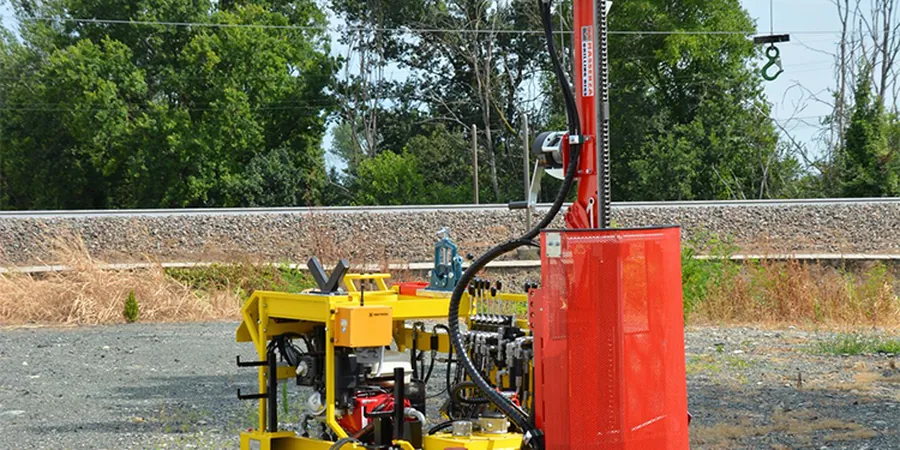
The SPT drilling rig we mobilise to Swords sites is a rubber‑tracked, remote‑controlled rotary‑percussion unit that can climb a 25° slope and fit through a standard side gate. The automatic hammer is critical; manual rope‑and‑cathead systems common on older rigs introduce energy losses that can inflate N‑values by 20‑30 %, a risk nobody can afford on a soil profile where a blow count of 15 versus 10 changes the bearing capacity calculation. Our crew runs the hammer calibration check against an instrumented rod at the start of every job, and the energy ratio is reported alongside the field N‑values. In the tight till deposits characteristic of north County Dublin, refusal can happen abruptly — the driller watches the penetration rate metre and switches to rotary coring the moment the sampler refuses, protecting both the borehole and the data continuity.
Frequently asked questions
What does an SPT test cost for a single‑house site in Swords?
For a typical residential plot in the Swords area, an SPT investigation with two boreholes to 10 m depth generally falls between €480 and €590 per hole, depending on access, traffic management requirements, and whether the rig can work on soft ground without mats. The price includes the driller, calibrated automatic hammer, split‑spoon sampling, field logs, and a factual report with N‑value profiles. If laboratory classification of the recovered samples is needed, that is quoted separately.
How many SPT boreholes does Fingal County Council normally require?
Fingal County Council planning conditions rarely specify a fixed number — they ask for a site investigation sufficient to characterise ground conditions. In practice, for a medium‑rise apartment block in Swords, the design team typically requests three to five SPT boreholes spaced on a grid matching the column layout, supplemented by trial pits in the access road footprint. The geotechnical report must demonstrate that the investigation covers the full building footprint and any retained cut slopes.
Can SPT data help avoid expensive piled foundations in Swords?
Often yes. Where SPT N‑values consistently stay above 15 below a depth of 2–3 m, strip or pad footings may be feasible, particularly on the stiffer lodgement tills found east of the R132. Even where piles are unavoidable, the SPT profile lets the engineer select a pile toe level in competent till rather than over‑conservatively socketing into limestone, which can save significant piling metreage and reduce the risk of pile damage during driving.