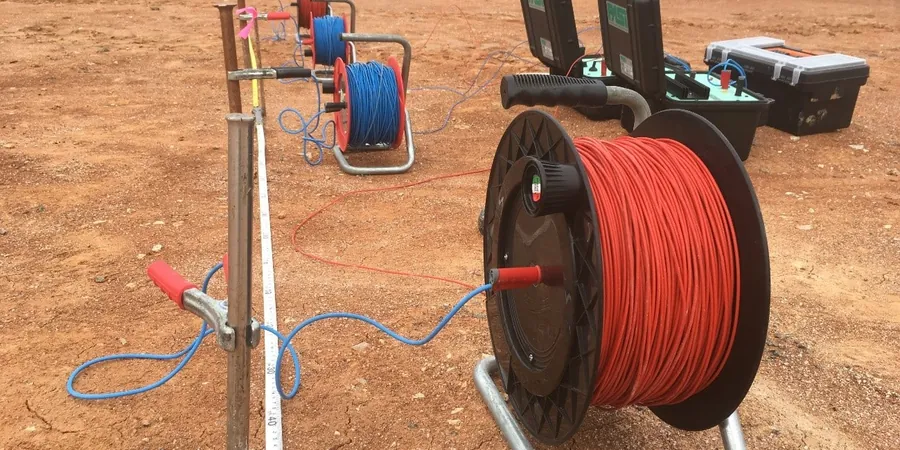
Swords sits on a complex glacial mix that shifts from stiff Dublin boulder clay to pockets of alluvial gravels along the Broadmeadow River corridor, making uniform foundation assumptions risky. With the town’s population now exceeding 42,000 and major developments like Swords Central pushing into former greenfield sites, we see a growing demand for subsurface mapping that goes beyond isolated boreholes. Vertical Electrical Sounding fills that gap by profiling resistivity contrasts across a continuous depth range, often reaching 30 to 50 metres below ground level. In our experience, a VES survey run before intrusive drilling helps position exploratory boreholes where they deliver the most geological value, especially when limestone bedrock is suspected at variable depths. We regularly pair this method with a seismic refraction survey when the client needs both velocity stratigraphy and water table depth on the same cross-section, which is particularly useful for commercial schemes near the M1 corridor where cut-and-fill volumes have to be estimated with precision.
A well-planned VES survey in Swords can locate the clay-rock interface within half a metre of its true depth, turning a risky mass excavation into a controlled earthworks operation.
Frequently asked questions
What does a VES survey in the Swords area typically cost?
For a standard Vertical Electrical Sounding survey in Swords, budgets generally fall between €580 and €1040, depending on the number of sounding points, the maximum depth required, and whether 2D tomography is included alongside the vertical soundings. We always provide a fixed-price proposal after reviewing the site plan and the specific questions you need answered.
Can resistivity testing distinguish between Dublin boulder clay and weathered limestone bedrock?
Yes, and this is one of the most useful applications of the method around Swords. The stiff boulder clay typically returns resistivity values in the 20 to 60 Ω·m range, while competent limestone jumps above 200 Ω·m. The weathered transition zone between the two shows intermediate values that our inversion software can model as a separate layer, which helps the geotechnical designer decide whether pad footings can bear on the till or need to be socketed into rock.
How long does a VES survey take, and will it disrupt site activities?
A single VES sounding takes about 45 to 60 minutes to set up, measure, and pack down, so a typical day on a Swords site allows us to complete four to six soundings. The equipment is entirely surface-based with four steel electrodes pushed a few centimetres into the ground, so there is no drilling noise, no cuttings to manage, and no disruption to concurrent earthworks or surveying crews.